
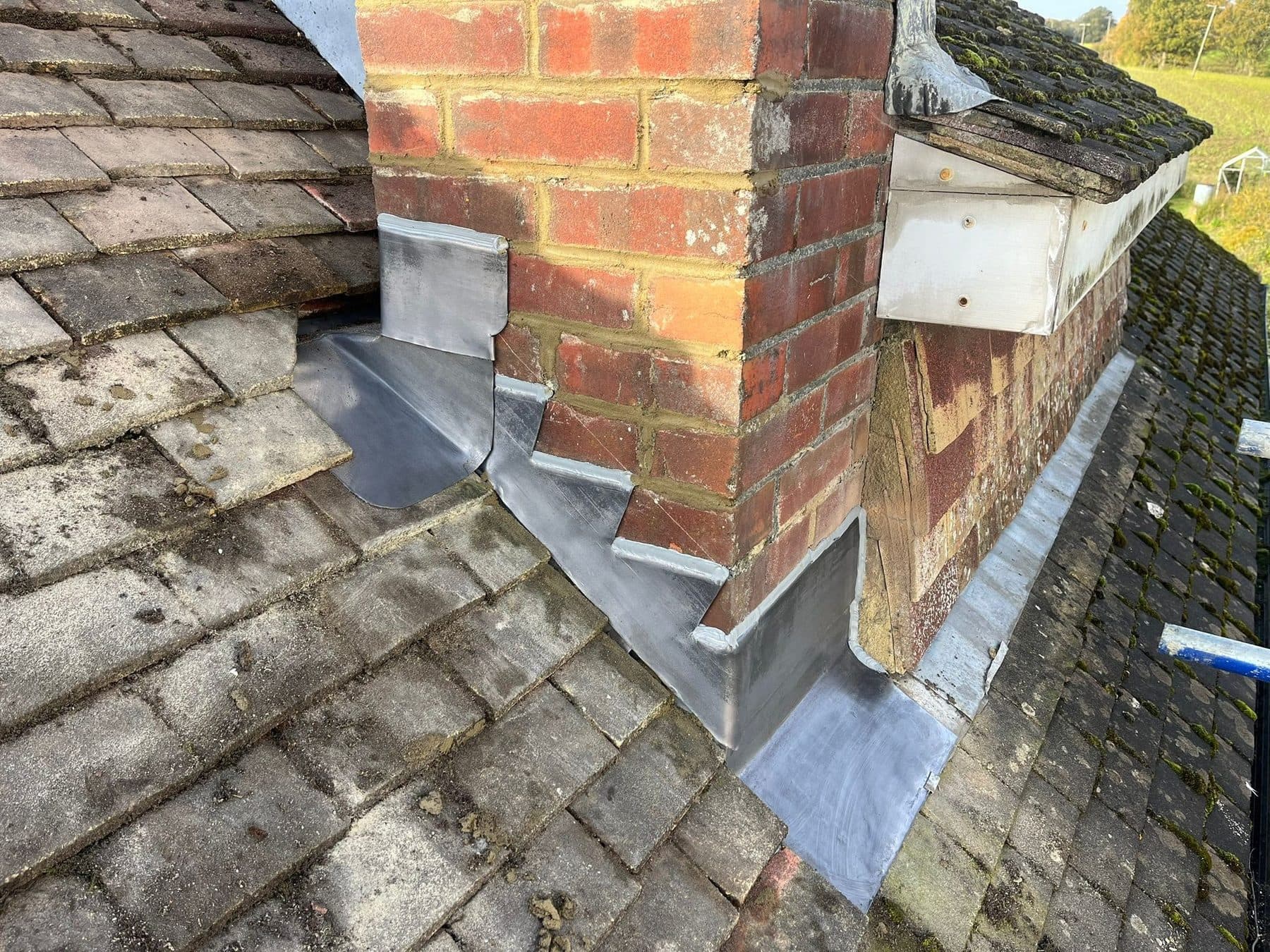
When a roof leaks around a chimney, the water is usually getting in through the lead flashing where the stack meets the tiles, through the back gutter on the uphill side of the stack, or through the top of the chimney itself, where cracked mortar, loose pots or an open flue let rain run down inside. Less often the tiles beside the stack have slipped, or the brickwork has become so porous that it soaks water through.
Which one it is decides the repair. A cracked mortar cap at the top of the stack is a small job; lead that has split or pulled out of the brickwork means lifting the tiles beside the chimney and dressing in new lead. And some damp on a chimney breast is not a leak at all. Below is how to tell them apart.
How a chimney is kept watertight
A chimney stack interrupts the roof, so every side of it needs something to turn water back onto the tiles.
- Step flashings run down the two sides. Each piece of lead is tucked into a mortar joint in the brickwork and dressed over the tiles, stepping down with the slope of the roof.
- The front apron sits across the downhill face of the stack and lies over the tiles below it.
- The back gutter is on the uphill side, where all the water running down the roof above meets the stack. It is a small lead gutter that carries that water round the sides.
- Cover flashings are tucked into the brickwork and lapped over the top edges of the lead below, so water running down the face of the stack cannot get behind.
- The flaunching is the sloped bed of mortar around the pots at the top of the stack, which throws rain off instead of letting it sit.
The photo at the top is one of our own chimney jobs, with new lead stepped down the side of the stack and an apron at its foot. Every one of those parts can fail on its own.
Where the water usually gets in
The lead flashing. Lead moves as it warms and cools. The Lead Sheet Association's guidance on repairing lead roofing and flashings names oversizing, often coupled with overfixing, as the main cause of failure. Pieces that are too long, or nailed so they cannot move, distort and eventually crack. Lead tucked into the brickwork can also work loose as the old mortar crumbles, and wind can lift a flashing that was never dressed down tightly.
The back gutter. On a large stack with a lot of roof above it, the back gutter takes far more water than anywhere else. Leaves, moss and debris collect in it, and when it fills the water spills over the lead and in under the tiles. A leak that only shows during heavy rain, low on the ceiling below the stack, often starts here.
The top of the stack. Flaunching cracks with age and frost, and once water gets into it the pots can loosen. An uncapped flue lets rain straight down the inside of the chimney. On one of our recent chimney repairs, the stack was finished with a fresh cement top around its two terracotta pots.
The brickwork and pointing. Mortar joints that have eroded let wind-driven rain into the stack. Water that gets into the brickwork above the roof can travel down inside it and appear as a damp patch on the chimney breast indoors, well below the roof.
The tiles beside the stack. A tile or slate that has slipped next to the flashing leaves a gap that no amount of lead will cover. That is an ordinary roof repair rather than leadwork.
How to tell which one you have
You can learn a lot without going near the roof.
- Look from the ground with binoculars or a zoomed phone camera. Lifted or torn lead, missing mortar between the bricks, cracked flaunching and leaning pots can all be seen from the garden or across the road.
- Look in the loft with a torch after rain. Water on the timbers beside the stack points to the flashing or the tiles next to it. Damp running down the brickwork of the stack inside the loft points to the stack itself.
- Note when it appears. A stain that grows during heavy rain and dries within days is a leak. Damp that appears when the wind drives rain at one face of the house points to the brickwork or the flashing on that side. A leak that started after a storm may be covered by your insurance, so photograph it and speak to your insurer before any repair.
- Damp that never dries out, or appears in cold dry weather, may not be rain at all. A chimney that is no longer used can hold moisture inside the flue, and soot and old deposits in the brickwork can draw damp out of the air and mark the plaster. That needs the flue looking at rather than the roof.
How each one is repaired
Lead flashing. Patching split lead with mastic or tape is at best a short-term measure; the Lead Sheet Association's guidance is that repair tapes do not usually last very long. The lasting repair is to lift the tiles beside the stack, take out the old lead, and dress in new step flashings, apron and cover flashings, each piece sized so it can move. The same guidance says cover flashings should be held in the brickwork with lead wedges, at most 500mm apart, and the joint pointed afterwards. That is the sequence in our recent chimney jobs, from the tiles beside a stack lifted and the old flashing coming out, to a new lead apron and step flashing dressed around the base of another.
The back gutter. If it is sound but blocked, clearing it may be all it needs. If the lead has split, or the gutter was formed too shallow to carry the water from the roof above, it is rebuilt in new lead.
The top of the stack. Cracked flaunching is hacked off and renewed around the pots, loose pots are reset, and a cowl or cap can be fitted to an open flue.
Pointing and brickwork. Joints that have eroded are raked out and repointed. Where the top courses of bricks have come loose, those courses are taken down and rebuilt.
None of these is usually a planning matter for an ordinary house. Repairs that match what is there do not normally need a building control application either, as long as they affect less than a quarter of the building's outer envelope and less than half of the roof. If your home is listed, check first. Historic England says like-for-like repairs may not need listed building consent, but changes to features of the roof are likely to.
Chimneys you no longer use
A stack with no fire under it still needs looking after, and blocking it off completely can cause the damp you were trying to stop. A disused flue that is sealed top and bottom has no air moving through it, so moisture that gets in stays in. Historic England's guidance deals with capping and venting disused flues, and the usual answer is a cap that keeps rain out but lets air through, with a vent left where the fireplace used to be.
Taking a stack down below the roof line is a bigger decision. It changes the roof, it can affect a neighbour where the stack is shared, and it can need building control involvement if the structure is altered. It is rarely the cheapest way to stop a leak.
When not to spend money on the chimney
- If the only fault is a blocked back gutter, clearing it costs far less than new lead. Ask for that first.
- If the damp is on a chimney breast in a room that is never heated and the roof looks sound, ventilation of the flue may solve it.
- If the stain is in a ceiling some distance from the stack, the chimney may not be the cause at all. Water can run along a batten or a rafter before it drips, so trace it before blaming the lead.
Getting the chimney checked
If you can see lifted lead, cracked flaunching or a stain spreading around the chimney breast, Kent & County Roofing repairs chimney stacks and leadwork on homes across Kent. Contact us with what you can see, which side of the stack the water shows on, and the postcode of the property.