
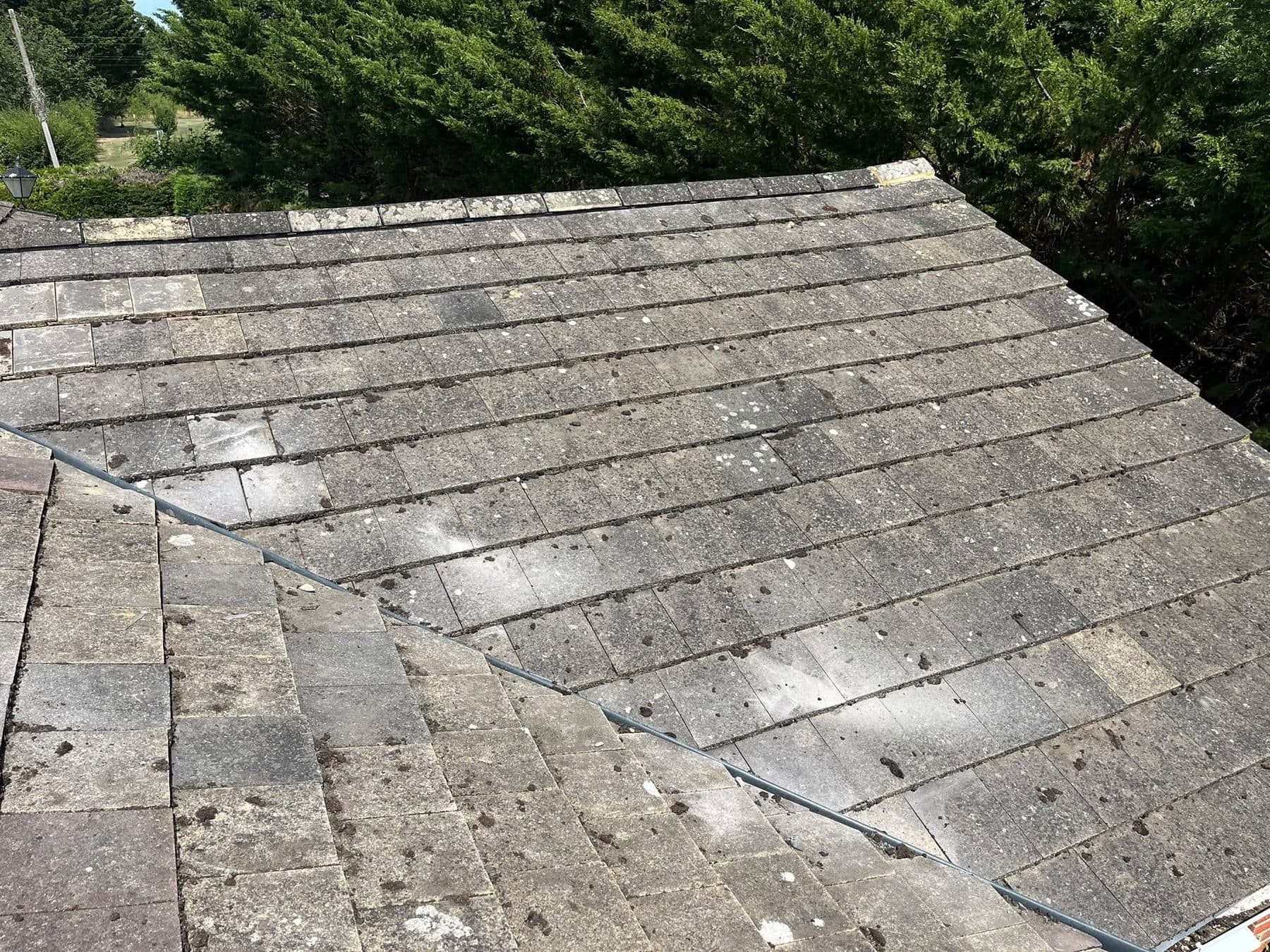
If a storm has damaged your roof, stay off it, make the inside of the house safe, photograph everything you can see from the ground, and ring your insurer before any permanent repair is done. Damage caused by storms is covered by most standard home insurance policies, and the Association of British Insurers' advice after a storm is to contact your insurer as soon as possible and speak to them before you arrange emergency repairs.
The order matters because of what happens next. An insurer, and the Financial Ombudsman if a claim goes to a dispute, will ask whether there really was a storm, whether the damage looks like storm damage, and whether the storm was the main cause or only showed up a roof that was already failing. The photos you take today and the report a roofer writes afterwards are what answer those questions.
Make the house safe first
Wind and wet tiles make a roof dangerous even for people who work on them every day, so nobody in the house should go up a ladder to look. Almost everything you need to know at this stage can be seen from the garden, the street or the loft hatch.
- Water through a ceiling. Put a bucket under the drip and move furniture and anything electrical out of the way. A ceiling that sags or bulges with water can come down, so keep everyone out of that room.
- Water near lights or sockets. Switch the electricity off at the consumer unit if you can reach it safely, and leave that circuit off until an electrician has looked at it.
- Tiles, slates or ridge pieces on the ground. More can follow in the next gust. Keep children, pets and cars away from that side of the house until the roof has been made safe.
- A chimney that has lost bricks or pots. Keep clear of the ground below it and say so straight away when you ring your insurer and a roofer.
Record the damage before anything is moved
Photographs taken on the day are the strongest evidence you will have. Take them before anything is tidied up or covered over.
- Every side of the roof from the ground, one wide shot and one zoomed in, so the position of each missing or slipped tile is clear
- Tiles, slates, lead or guttering lying on the ground, where they landed
- Ceiling stains, wet patches on walls, and anything damaged inside
- The loft, if you can get into it safely, looking for daylight, wet insulation or water on the boards
Write down the date and roughly when you first noticed the damage. Keep the broken pieces too. The ABI's advice is not to be in a rush to throw damaged items away, unless they are a danger to health, because your insurer may want to see them.
It also helps to note the weather. When the Financial Ombudsman Service settles a storm damage complaint, it looks at official weather reports for the date and place the damage happened. A screenshot of the Met Office warning that covered your part of Kent that day is easy to save now and hard to find later.
Temporary repairs, and who pays for them
Stopping more rain getting in is part of limiting the damage, and insurers expect it. The ABI's advice is to arrange temporary emergency repairs if they are needed to stop the damage getting worse, to speak to your insurer first, and to keep every receipt if you have to arrange the work yourself, because it forms part of the claim.
A temporary repair is exactly that. It might be a sheet weighted over a hole, slipped tiles pushed back and secured, or a cover over an open stretch of ridge. It keeps the weather out until the permanent repair is agreed, and it should be photographed before and after so the insurer can see what was found.
Ask whoever does the temporary work to put in writing what they found and what they did. The Ombudsman says it usually relies on expert reports and photos, and that an insurer will normally ask a surveyor to write a report of their own. A roofer's written note made on the day, separating fresh storm damage from older wear, gives you something to set beside it.
What your insurer will check
The Financial Ombudsman's definition is a useful starting point. It says a storm usually involves violent winds, usually with rain, hail or snow, and that heavy rain, hail or snow on its own can sometimes be enough. When a storm claim is turned down and the customer complains, it works through three questions.
- Was there a storm on the date the damage happened?
- Is the damage consistent with what is generally seen as storm damage?
- Were storm conditions the main cause, or might the damage have happened anyway?
The third question is where most arguments start. Many policies exclude wear and tear and gradual damage, and the Ombudsman says it is unlikely to uphold a complaint where the roof was already in poor condition and the owner knew about it, or where the storm simply highlighted an existing problem. It also says the insurer has to prove an exclusion applies, for example with an inspection report, and that a roof in poor condition does not always mean the storm was not to blame. Before you take a complaint to the Ombudsman you need to have made a formal complaint to the insurer first.
The parts of a roof a storm usually finds
Wind does not damage a roof evenly. It works at the edges and the joins, and anything that was already loose goes first.
Ridge and hip tiles. The row of tiles along the top of the roof takes the full force of the wind. Where they sit on old mortar that has cracked, they can rock and then lift. A ridge can be rebedded on fresh mortar or fixed with a dry ridge system, where the tiles are screwed or clipped down over a ventilated roll instead, and both turn up among the ridges we have relaid.
Verges. The tiles along the gable ends of a roof catch the wind side on and are often held only by mortar.
Slipped tiles and slates. A tile or slate that was already held by a corroded nail or a broken nib can be pulled out by a gust, and the rain then gets in through the gap it leaves.
Lead flashing. Where the roof meets a chimney, a wall or a dormer, the lead flashing can be lifted by wind and stay lifted, so the next rain runs straight behind it.
Flat roof edges. On a garage, an extension or a dormer, wind gets under a loose edge trim and can peel a flat roof covering back. The Ombudsman uses a flat roof as its own example of a storm claim, and the same three questions apply.
Gutters and fascias. Gutters full of leaves catch the wind and pull on their brackets, and a fascia board that has rotted behind can come away with them.
Most storm damage is put right with roof repairs to the parts that failed. Where a roof has lost a large area of tiles, or the battens and felt under them turn out to be worn through, re-roofing is usually the better job.
When you might not need to spend money
Not everything that looks bad after a storm is damage.
- Water pouring over the front of a gutter during a downpour is more often a blocked gutter or downpipe than a broken one. Check again once the rain stops.
- Moss, leaves and twigs washed off the roof onto the drive are untidy, not harmful.
- If only one or two tiles have slipped and nothing is getting in, check your excess before you claim. A small refix can cost less than the excess.
- If the roof was leaking before the storm, an insurer is likely to treat it as wear and tear. It is still worth fixing promptly, but plan it as a repair rather than a claim.
Be wary of knocks at the door after a storm
Doorstep traders follow bad weather. They will point at a problem on your roof that you cannot see, quote a price on the spot and ask for cash before they start. Do not agree to work at the door, get written quotes before you choose anyone, and never go to a bank or a cash machine with a trader. If someone has pressured you or a neighbour, you can report them to Trading Standards through Citizens Advice.
Getting the roof looked at
If the storm has left you with slipped tiles, a lifted ridge, loose lead or water coming in, Kent & County Roofing repairs storm damage on homes across Kent. Contact us with what you can see and the postcode of the property, and tell us if you are claiming on your insurance.